

Your lease ends in five weeks. Half the team already works from home, the third floor has been dark since spring, and somewhere in the back room there are forty filing boxes nobody has opened since 2017. There are also eleven monitors, a copier the size of a chest freezer, and twenty-two workstations that cost real money in 2015 and are worth almost nothing now.
An office cleanout in Cincinnati is the job of clearing a commercial space of furniture, equipment, electronics and records so the property can be handed back to a landlord, listed, renovated or re-leased. It sounds like junk removal with a bigger truck. It isn’t. A business cleanout runs into things a house never does: a building that requires proof of insurance before a crew walks in the door, records you’re legally required to destroy a particular way, hard drives that still hold client data, and a lease clause that quietly decides whether you owe one month’s rent or three.
This guide covers the whole job in the order it happens — what triggers a cleanout, how to plan one without stopping work, the building rules that trip up most businesses, and where the furniture, electronics and paper actually go. Each section links to a deeper guide when you need the detail.
What Counts as an Office Cleanout
Office cleanout and office decommissioning get used interchangeably. Both mean the same practical thing: emptying a commercial space and returning it in the condition your lease requires.
The jobs that bring most Cincinnati businesses to this point:
- A move. You’re relocating and the new space is smaller, already furnished, or styled differently. Most of the old furniture isn’t coming.
- Downsizing. Hybrid work left you paying for square footage nobody sits in, so you’re giving back a floor or consolidating suites.
- A closure. The business is winding down, a location is closing, or a lease simply ran out.
- A renovation. The space stays, but everything inside it has to come out first.
- A tenant left it behind. Property managers and landlords inherit abandoned furniture and equipment more often than people think, which is its own job — see clearing a commercial space between tenants.
- Years of accumulation. Nothing is changing except that the storage room, server closet and back hallway have stopped being usable.
Whatever the trigger, the finish line is the same: an empty, broom-clean space, with records destroyed properly, electronics handled properly, and documentation you can show a landlord, an auditor or an accountant.
Start With the Lease, Not the Furniture
This is the step businesses skip, and the one that causes the most damage.
Buried in every commercial lease is a surrender clause that defines the condition you must return the space in. The most tenant-friendly version is “broom clean” — remove your property and leave the space swept and free of debris. A stricter version requires restoration: undo the alterations you made. Those two standards are very different jobs. If you built out a conference room, added partition walls, ran cabling above the ceiling tiles or installed signage, restoration may mean taking all of it back out and repairing what’s behind it.
Sitting next to it is the holdover clause, which sets the penalty if you don’t finish on time. Holdover rent is commonly set well above your normal rate, and it typically isn’t prorated — run a few days past the surrender date and you may owe the full month at the penalty rate. Leaving a pile of furniture behind, or keeping a set of keys to finish up, can be enough for a landlord to argue the space was never properly surrendered.
Read both clauses before you book anything, then work backward from the surrender date rather than forward from today. Our office move-out checklist for Cincinnati businesses lays that countdown out week by week, including the notices and inspections that run alongside the physical work.
The Four-Stream Method: How to Sort a Commercial Space
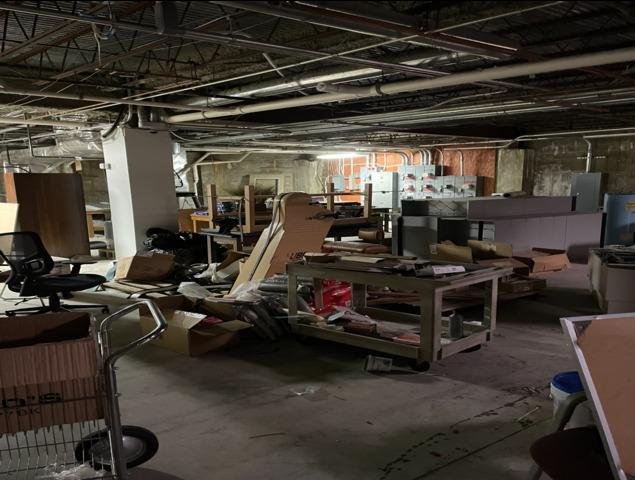
Sorting a house is emotional. Sorting an office is logistical. The fastest approach is to stop thinking in rooms and start thinking in streams, because each stream has a different destination and a different lead time.
Stream 1 — Keep and move. Everything going to the new space. Tag it, inventory it, and physically separate it, ideally in one room with the door closed. Crews work much faster when “keep” is a place, not a sticker hunt.
Stream 2 — Resale and donation. Furniture and equipment in good condition. This stream has the longest lead time of the four, because liquidators need to assess and charities need to schedule pickups. Start it first.
Stream 3 — Secure destruction. Paper records, hard drives, backup media, old phones. This stream has legal requirements attached and cannot be lumped in with general hauling.
Stream 4 — Recycle and dispose. Everything else: broken furniture, carpet, old cabling, general debris.
The common mistake is running these in parallel and discovering in the final week that the donation pickup needs ten days’ notice, the shredding vendor needs a scheduled visit, and the freight elevator is booked. Streams 2 and 3 start early. Stream 4 is last, and it’s the only one where speed actually helps.
The Building Rules Nobody Warns You About
This is where commercial work separates from residential, and where most first-time cleanouts lose a day.
Certificate of Insurance. Most managed office buildings, medical complexes and multi-tenant properties require any vendor working on site to submit a Certificate of Insurance before the job, often naming the building owner and property manager as additional insured. Approval can take several business days. Ask your property manager what they need in week one, not the morning of the haul — a crew that arrives without an approved COI gets turned away in the lobby.
Elevator and dock reservations. Freight elevators get booked, and some buildings only release them outside business hours. Loading docks have time windows and height limits. If the building requires protective padding or floor protection, somebody has to install it.
After-hours and weekend work. Many buildings won’t allow a cleanout during business hours at all, because you can’t run furniture through a shared lobby while other tenants are working. That pushes the job into evenings or a weekend, which changes the schedule for everyone involved.
Suite and corridor access. Older Cincinnati office stock — converted buildings downtown, in Over-the-Rhine, along the Reading Road corridor and in the older Norwood and Oakley commercial strips — often has narrow service corridors, small elevators or stairs-only upper floors. A conference table that went in before a wall was built sometimes has to come apart to come out.
Site rules for the crew. Badges, sign-in, parking, where the truck can stage. Sort it out in advance.
Your Three Options for Clearing the Space
| In-house with staff | Roll-off dumpster | Full-service cleanout crew | |
|---|---|---|---|
| Who does the lifting | Your employees | Your employees | The crew |
| Best for | A few desks, one small suite | Renovation debris, ground-floor space with room for a container | Full suites and floors, deadlines, upper floors, mixed material |
| Watch for | Injury liability, lost work hours, no plan for e-waste or records | Permits for street placement, no sorting, no donation | Quotes that exclude disposal, stairs, disassembly or after-hours work |
| Donations handled | You haul them | No | Usually, if you ask |
| Documentation | None | None | Receipts, donation and recycling records |
The in-house option looks free and rarely is. Pulling five employees off work for a day and a half is real payroll against real output, and a back injury during a cubicle teardown is a workers’ comp claim. Dumpsters make sense for demolition debris and ground-floor spaces, less sense when everything travels down one elevator at a time, and no sense at all for electronics or records.
Where Everything Ends Up
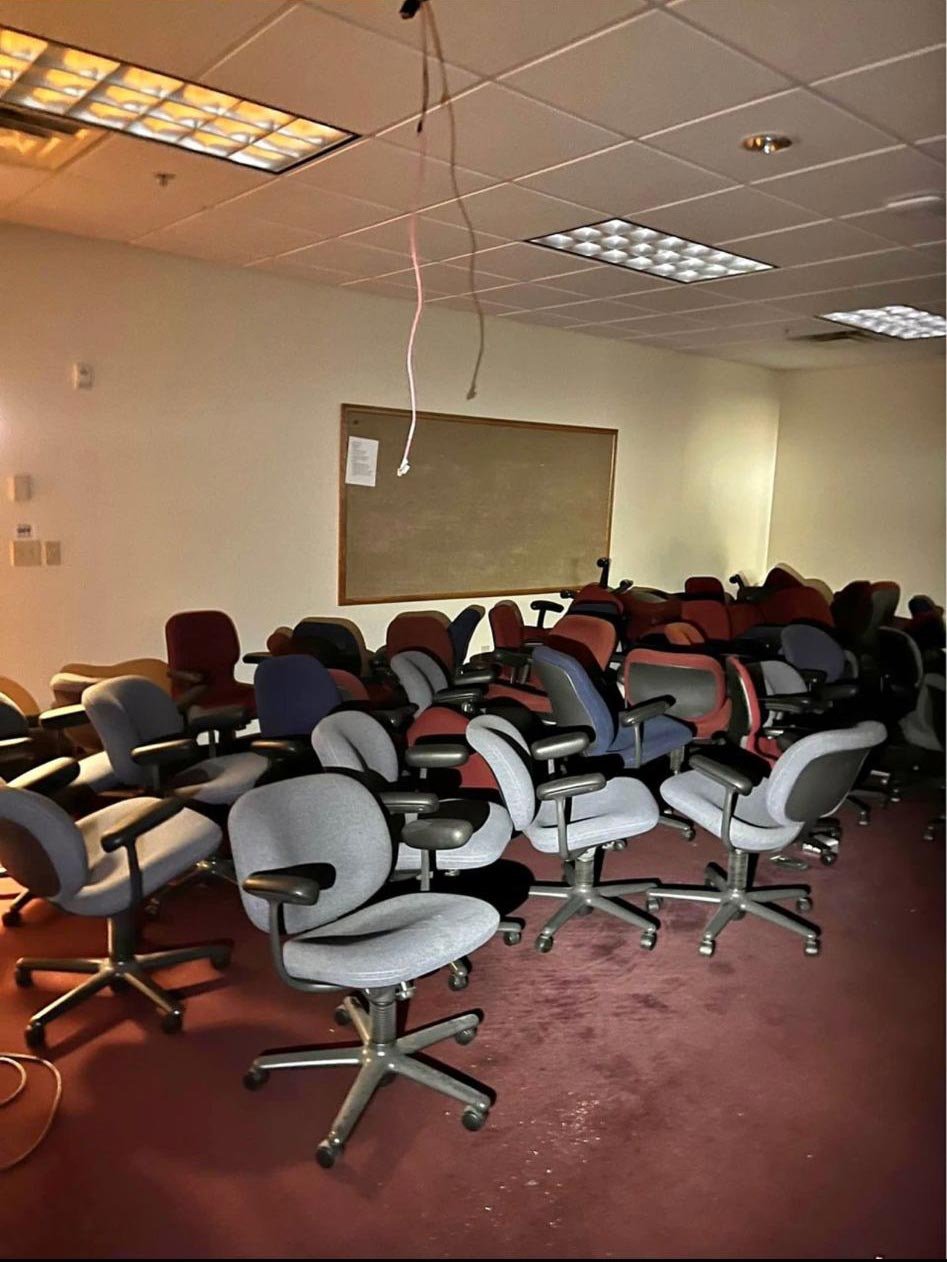
Furniture. Expect less than you hope. The used office furniture market is heavily oversupplied, and only newer, name-brand inventory in good condition holds meaningful resale value. Older cubicle systems and laminate desks generally don’t. Donation is usually the better outcome for mid-grade furniture, and it comes with a paper trail. Full breakdown in office furniture disposal.
Electronics. Computers, monitors, printers, servers, phones, networking gear. Worth knowing: Hamilton County’s free electronics drop-off programs are set up for residents, with proof of residency required. They are not a disposal channel for a business clearing a server closet. Businesses go through commercial recyclers, or a cleanout company that routes e-waste to one.
Records and data. The FTC’s Disposal Rule requires businesses holding consumer report information to take reasonable measures when disposing of it — the agency points to burning, pulverizing or shredding paper, and destroying or erasing electronic media so it can’t practicably be read or reconstructed. Healthcare practices have HIPAA obligations on top. Both are covered in what to do with old office computers and files.
Everything else. Metal filing cabinets and shelving are scrap metal and recycle well. Cardboard recycles. Carpet, laminate and broken particleboard usually don’t.
A Realistic Timeline
Six to eight weeks out: read the lease, confirm the surrender standard, notify the property manager, start the vendor COI process, and get liquidators or charities in to look at the furniture.
Four weeks out: take an inventory. Decide what moves. Book shredding and e-waste handling. Get on-site cleanout estimates.
Two weeks out: reserve the elevator and dock. Tell staff what happens to their personal items and desk contents, and give them a date. Start the records purge with whoever owns your retention policy.
Final week: keep-items get pulled and isolated. Donation pickups happen. IT disconnects and wipes equipment.
Haul days: a typical small suite clears in a day. A full floor or multi-suite office usually takes two or three, depending on elevator access and how much disassembly is involved.
After: final walkthrough with the property manager, keys and badges returned in writing, documentation filed.
Seven Questions to Ask Before You Hire
- Can you provide a Certificate of Insurance naming our building owner and property manager? If the answer is vague, stop there.
- Will you give an on-site estimate? Nobody can assess a suite over the phone, least of all a storage room they haven’t seen.
- What’s included, and what isn’t? Disposal, stairs, disassembly, after-hours work.
- Can you work evenings or a weekend if the building requires it?
- What happens to usable furniture and to electronics? Ask which charities and recyclers.
- Can you provide receipts and donation documentation? Finance will want them.
- Will the space be left broom-clean, and will you confirm that in writing?
How SEN Hauling Handles Office Cleanouts in Cincinnati
SEN Hauling & Junk Removal is a locally owned, eco-minded crew working across Cincinnati, surrounding Ohio communities and Northern Kentucky. For commercial work, that means:
- A free, no-obligation on-site estimate. We walk the suite, look at the access and elevator situation, and give you a clear scope in writing before anything moves.
- No surprises on the day. What we agree on site is what we do, and payment happens after the work is finished.
- Donation and recycling first. Usable furniture and equipment are routed to donation where possible, metals and electronics go to recyclers, and only what’s left goes to disposal.
- Uniformed crews that work around your tags. Anything marked to keep stays put.
- Scheduling that fits the building. Same-day and next-day availability is often possible when a surrender date is close.
If you’re working toward a lease end or a move date, see our office cleanout services in Cincinnati, OH and book a free on-site estimate.
Frequently Asked Questions
How long does an office cleanout take?
Once sorting is done, a small suite usually clears in a day and a full floor in two to three. The variable is almost never the volume — it’s the access. One freight elevator, a narrow service corridor or an after-hours-only building can double the time a job takes.
Do we have to be closed during the cleanout?
Not always. Many businesses clear in phases: storage and vacated areas first, active workspace last. If your building restricts moving to evenings or weekends, the work happens outside business hours anyway, which usually means no disruption at all.
What does “broom clean” actually mean?
It’s the most tenant-favorable surrender standard: remove all your property and leave the space swept and free of debris. It does not mean deep cleaning, patching walls or undoing alterations. If your lease requires the space returned to its original condition, that’s a restoration standard and a bigger job — check the exact wording.
Who is responsible for a cleanout, the tenant or the landlord?
Normally the tenant, as part of meeting the surrender obligation. Landlords and property managers take it on when they’re clearing a space a previous tenant abandoned, prepping for a new tenant, or handling a unit after an eviction.
Can a cleanout company take our old computers and printers?
Most can, and this is worth asking about specifically. Hamilton County’s free electronics drop-offs are for residents with proof of residency, so businesses need a commercial route. Ask where the e-waste goes and whether hard drives are handled separately.
What happens to furniture that’s still in good condition?
A responsible crew sorts as it loads and routes usable desks, chairs, tables and cabinets to local charities and reuse organizations rather than the landfill. Ask for donation documentation — your accountant may want it.
Do you handle office cleanouts in Northern Kentucky?
Yes. SEN Hauling serves Cincinnati, the surrounding Ohio communities and Northern Kentucky, including Covington, Newport, Florence and the nearby business corridors.
The Takeaway
An office cleanout goes smoothly when it runs in the right order: read the lease first, start the slow streams early, clear the building’s insurance and elevator requirements before haul day, and leave the fast work for last. Start with the week-by-week move-out checklist, and when you’re ready for the heavy part, book a free on-site estimate so you know exactly what the last step involves.