


Someone on your team has already said it: “We paid a fortune for these desks, we should be able to sell them.”
It’s a reasonable instinct and it’s usually wrong. Office furniture disposal is one of the few areas where the market has moved sharply against sellers. Remote work put an enormous volume of used desks, chairs and cubicle systems into circulation at exactly the moment demand for them fell. What that means in practice: a small number of pieces have real resale value, most have some donation value, and the rest is a logistics problem rather than an asset. This guide sorts yours into those three groups. For how furniture fits into the larger job, see our complete guide to an office cleanout in Cincinnati.
The Four Routes, in the Order You Should Try Them
- Reuse — keep it, move it, or redeploy it to another location
- Resell — through a liquidator, dealer or direct sale
- Donate — to nonprofits, schools, churches and reuse organizations
- Recycle or dispose — metals to scrap, the rest to disposal
Work the list top to bottom. Each step down recovers a little less, so anything that can be handled at a higher step should be.
What Actually Has Resale Value
Industry people who buy used office furniture for a living will tell you the same thing: the secondhand market is oversupplied, and only a narrow band of inventory moves reliably.
| Usually has resale value | Rarely has resale value |
|---|---|
| Name-brand ergonomic task chairs (Herman Miller, Steelcase, Haworth) in good condition | Generic task chairs, especially with worn fabric or broken gas lifts |
| Height-adjustable sit-stand desks, recent models | Older fixed-height laminate desks |
| Modern benching systems, matched sets | Older cubicle systems with fabric panels |
| Solid wood executive furniture in good condition | Veneer and particleboard executive sets |
| Quality conference tables | Chipped or water-damaged anything |
| Good-condition metal lateral files | Mismatched single pieces |
| Recent monitor arms, docks and accessories | Anything with company branding applied |
Two rules decide most of it. Matched sets sell; singles don’t — a liquidator wants twenty identical chairs, not twenty different ones. And condition grades matter more than original price — buyers grade inventory, and a premium chair with a torn seat drops out of the sellable band entirely.
Be realistic about the effort, too. Listing pieces individually recovers the most per item and consumes the most time, which is exactly the resource you don’t have during a move-out. For most businesses, the question isn’t “could we get more?” but “is chasing it worth the weeks it takes?”
Your practical options for the sellable portion:
- A liquidator or used dealer who assesses on site and takes the lot. Fastest and lowest effort.
- Direct sale to another business, which works best when another local company is furnishing a similar space at the same time. Brokers sometimes know of a match.
- An employee sale, which clears smaller items and generates real goodwill out of furniture nobody else would have bought.
Donation: Usually the Better Outcome
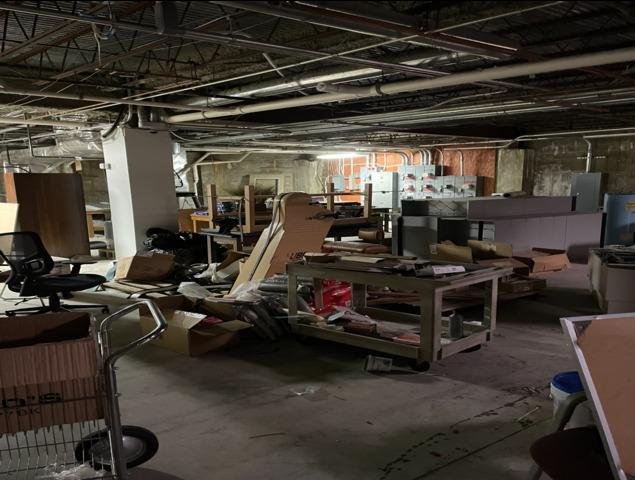
For the broad middle of your inventory — functional, unremarkable, not worth a dealer’s time — donation does more than disposal and takes about the same effort.
Organizations that commonly accept office furniture in the Cincinnati area:
- Habitat for Humanity ReStore, with locations around Greater Cincinnati including Cheviot, Bond Hill, Fairfield, Bellevue and Florence. Call the specific store about large-item pickup and current needs.
- Local nonprofits, charter and parochial schools, churches and community organizations. These are often the best match for desks, tables and chairs, and a direct offer gets further than a general inquiry.
- Startup incubators, co-working spaces and small business associations, which periodically need to furnish space on a tight budget.
- Goodwill and similar thrift operations for smaller items, accessories and storage pieces.
Three things make a donation go through instead of falling apart:
Ask early. Charities schedule pickups weeks out and have limited storage. A call four weeks before your surrender date gets a yes far more often than a call four days before.
Send photos first. Nobody wants a surprise truckload. Photos of actual condition, with quantities, let the organization say yes to the useful half and decline the rest.
Be honest about condition and logistics. If the desks need disassembly or the pieces are on the third floor with one elevator, say so. Most nonprofits don’t have a moving crew.
Keep the documentation. Get a donation receipt listing what was given and when. Your accountant will want it, and the treatment of a business donation depends on the entity and how the furniture was carried on the books — worth a short conversation with them rather than an assumption.
What charities usually decline: broken or wobbly furniture, chairs with failed gas cylinders, anything with torn or stained upholstery, older cubicle panels, particleboard pieces that won’t survive a move, and anything branded with your logo.
Cubicles Are Their Own Problem
Cubicle systems deserve a separate mention because they’re the single most common point of failure in an office cleanout plan.
They’re bulky, they have almost no resale market unless they’re recent and matched, charities rarely want them, and they have to be disassembled panel by panel to get out of the building. A twenty-station cubicle farm is not twenty items — it’s hundreds of panels, brackets, work surfaces, bins and connectors, plus the labor to separate them.
Plan for cubicles specifically:
- Count workstations and identify the system and approximate age before you ask anyone for an estimate.
- Decide early whether they’re being resold as a system, because a liquidator who wants them will want them intact and will usually pull them themselves.
- If they’re being removed, assume disassembly labor and say so when you request quotes.
- Check whether panels have power and data running through them. Those need to be disconnected properly before anything comes apart.
What’s Left: Recycling and Disposal
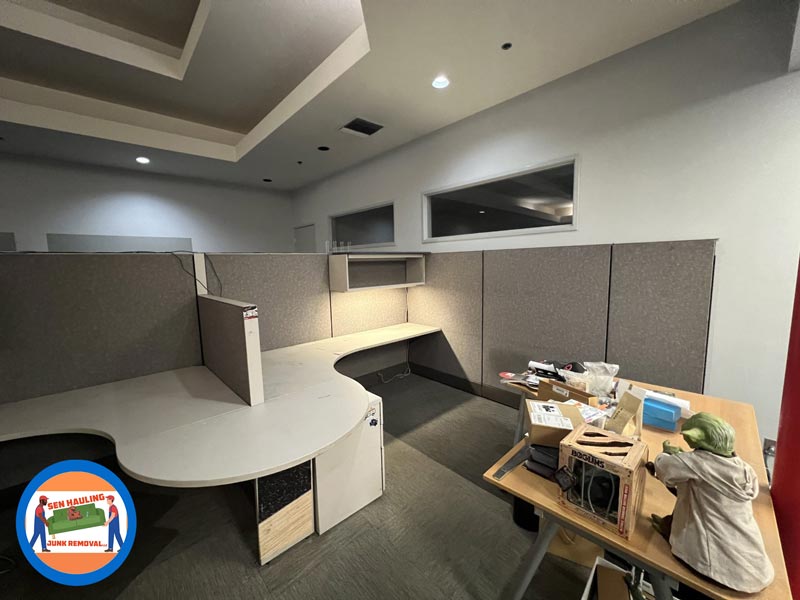
Metal recycles well. Lateral and vertical filing cabinets, steel shelving, metal desk frames, storage lockers and cubicle frames are scrap metal, and a good cleanout company routes them accordingly rather than to landfill.
Cardboard and clean paper recycle, which matters more than it sounds during a move when boxes pile up fast.
Mixed-material furniture mostly doesn’t recycle. A laminate desk is particleboard, plastic edging, metal fasteners and sometimes glue — technically separable, practically not worth it. The honest answer for most broken furniture is responsible disposal.
Break room appliances have their own rule. Refrigerators, freezers and water coolers containing refrigerant require that refrigerant to be recovered before disposal under federal rules. Flag these when you ask for an estimate.
Anything electronic — monitors, computers, printers, phones — follows a different path entirely, covered in what to do with old office computers and files.
Office Furniture Disposal: A Simple Sorting Pass
Walk the space once with a notepad and sort everything into four groups, then act on them in this order:
- Moving with us. Tag it and isolate it in one room.
- Worth a dealer’s look. Matched sets, name-brand chairs, recent desks. Call a liquidator this week.
- Donate. Functional, unremarkable, complete. Call charities this week too — they’re the slowest to schedule.
- Clear. Broken, branded, obsolete or outlasted. This is what the crew hauls on the final day.
If a piece is hard to categorize, it’s almost always group 3 or 4.
How SEN Hauling Handles Office Furniture
SEN Hauling & Junk Removal clears office furniture across Cincinnati, surrounding Ohio communities and Northern Kentucky — desks, chairs, conference tables, filing cabinets, shelving, cubicle systems and break room furniture, including disassembly when pieces won’t fit through a door or elevator.
Usable furniture is routed to local charities and reuse organizations wherever possible, metals go to recyclers, and only what can’t be reused or recycled goes to disposal. Estimates are free and done on site, so the scope is clear before anything moves.
Frequently Asked Questions
Can I sell my old office furniture?
Some of it. Recent name-brand ergonomic chairs, sit-stand desks and matched modern benching systems have a real market. Older laminate desks, generic chairs and dated cubicle systems generally don’t, because the secondhand market is oversupplied. A liquidator can tell you in one walkthrough which category yours falls into.
Who takes donated office furniture in Cincinnati?
Habitat for Humanity ReStore locations around Greater Cincinnati accept furniture and building materials, and local nonprofits, schools, churches and community organizations are often the best fit for desks, tables and chairs. Call ahead with photos and quantities — acceptance depends on condition and what they currently have room for.
What do companies do with cubicles when they move?
Most don’t take them. Cubicle systems rarely fit a new layout, have limited resale value unless they’re recent and matched, and require panel-by-panel disassembly to remove. The usual outcome is removal and recycling of the metal components, with resale only when the system is newer and a buyer wants it intact.
Do charities pick up office furniture?
Some will, depending on the organization, the quantity and the access. Pickups book out, so ask three to four weeks ahead rather than in your final week. Upper floors without a service elevator are a common reason a pickup gets declined.
Can old filing cabinets be recycled?
Yes. Metal filing cabinets, steel shelving and metal desk frames are scrap metal and recycle well. Empty them first, and handle the contents through secure document destruction if they held records.
What happens to furniture that’s too damaged to donate?
Metal components go to scrap recycling. Mixed-material pieces like laminate desks are generally not recyclable in practice and go to responsible disposal. A good cleanout company separates these as it loads rather than sending everything to one place.
The Bottom Line
Office furniture disposal gets easier once you accept that most of it isn’t an asset. Pull out the narrow band that a dealer genuinely wants, donate the functional middle while there’s still time to schedule a pickup, recycle the metal, and let the rest go. The businesses that struggle are the ones that spend four weeks trying to sell what was never going to sell, then run out of time on the part that actually mattered.